The Raleigh Mystery
By Dr Geri Parlby, Tavistock Heritage Trust
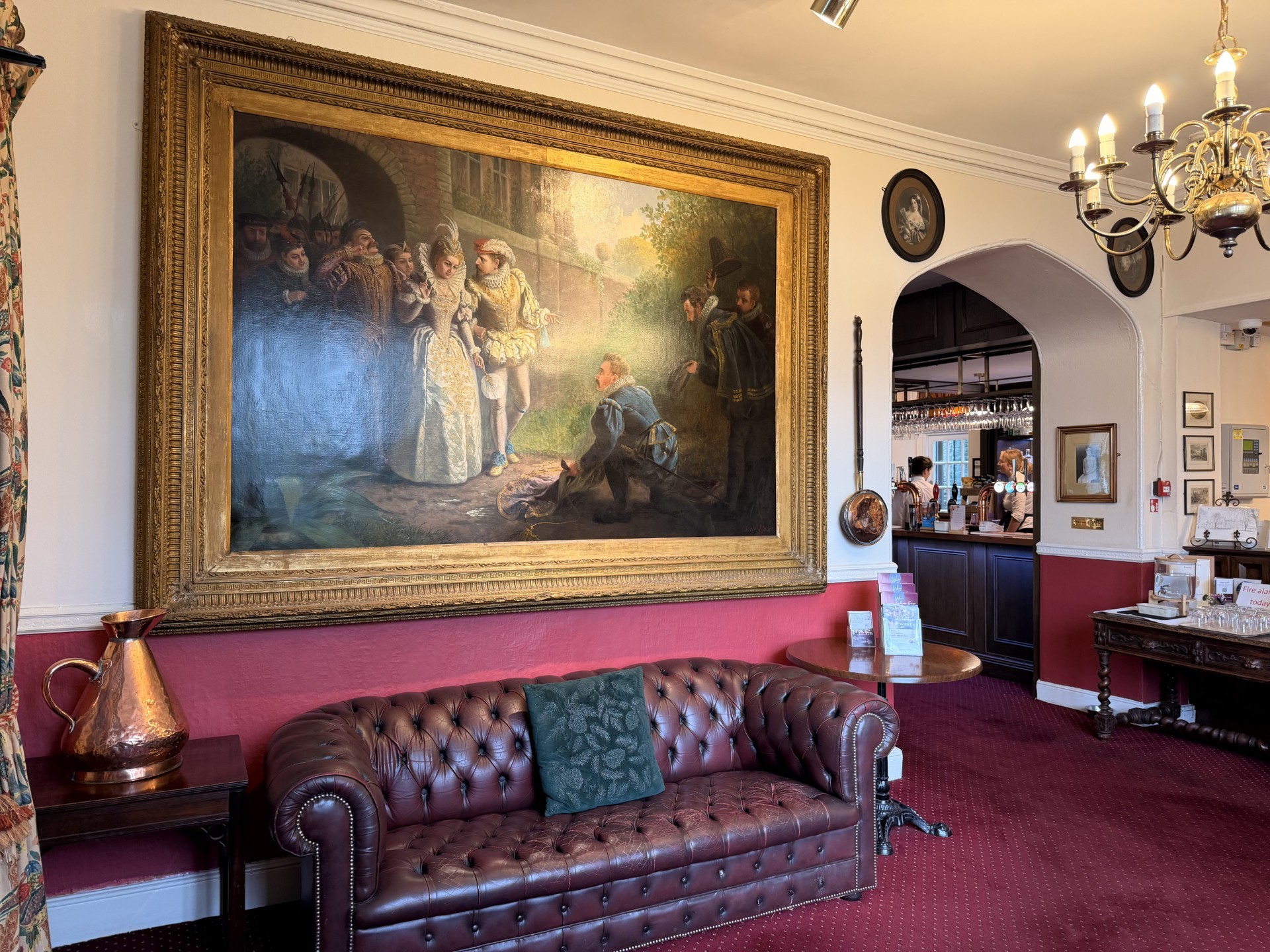
The large impressive painting in The Bedford Hotel reception area, was the only fixture when Warm Welcome Hotels purchased the hotel in October 1999. The hotel recently commissioned local fine art restorative expert Adrian Phippen, to restore the painting which had deteriorated from light exposure over the years. Art historian Geri Parlby has taken a look into the painting’s past.
A Tudor hero, a Victorian painting and Tavistock’s forgotten links
Few visitors entering The Bedford Hotel fail to notice the magnificent painting dominating the entrance hall. Set within an elaborate gilded frame it depicts one of the most enduring legends of the Tudor age: Sir Walter Raleigh gallantly laying his cloak across a muddy puddle so that Queen Elizabeth I could pass without soiling her shoes.
Whether fact or carefully crafted myth, it has become one of the defining images of Elizabethan chivalry. No one is sure how the painting came to be there - or why Raleigh should occupy such a prominent position, rather than Tavistock’s own celebrated Tudor hero, Sir Francis Drake.
As the painting emerged from beneath decades of varnish and dust, in the experienced hands of local art restorer Adrian Phippen, one mystery began to unfold - but another quickly took its place. The signature along the lower edge identified the artist as Charles Stuart, a London painter whose work enjoyed considerable popularity during the Victorian boom in art collecting. Stuart was painting at a time when Britain’s expanding middle classes were transforming the art market.
Railways carried pictures to exhibitions across the country, while the Art Union lottery encouraged thousands of new collectors to buy original paintings. Artists suddenly found themselves competing for a much broader audience than ever before.
Yet what makes The Bedford Hotel painting so intriguing is that it is entirely unlike the work on which Stuart had built his reputation. Born into a family of artists, Stuart had made his name painting fruit. Bowls of grapes, peaches and plums were exactly the sort of respectable, decorative pictures Victorian households wanted on their walls. They were attractive, affordable and reassuringly uncontroversial - and Stuart painted them exceptionally well. Then, in 1872, he did something completely different and produced a large, ambitious history painting, depicting Sir Walter Raleigh and Queen Elizabeth I - an extraordinary departure.
Why? The timing offers a few tantalising clues. Stuart and his wife, the successful artist Jane Maria Bowkett, shared both a home and a studio, and almost certainly discussed ideas that would appeal to the market. The previous year John Everett Millais had enjoyed enormous acclaim with his painting The Boyhood of Raleigh, depicting the young Walter Raleigh and his brother listening spellbound to an old sailor recount tales of adventure, symbolising the birth of Raleigh’s lifelong passion for exploration. The painting rekindled public enthusiasm for Elizabethan subjects. At much the same time Jane had turned to Sir Walter Scott’s hugely popular novel Kenilworth, first published in 1821 and set at the court of Elizabeth I. Its main story concerns the tragic romance of Amy Robsart and the Earl of Leicester and Jane painted two versions of its tragic heroine. Scott’s novel also helped popularise the famous tale of Raleigh spreading his cloak, which almost certainly never happened but perfectly captured Victorian ideals of loyalty, romance and chivalry. It is easy to imagine Charles and Jane leafing through Kenilworth together in search of their next successful subject: Jane choosing tragic romance, Charles choosing heroism.
And then... nothing. As far as we know, Stuart never painted another literary or historical subject. The Raleigh picture was not exhibited at the Royal Academy, nor has any record yet been found of it appearing elsewhere. Instead, he abandoned painting both history and fruit, turning to landscapes for the rest of his career. It proved a successful decision. By the 1880s the family had moved to an impressive house in West Hampstead complete with a purpose-built studio, where Charles, Jane and their artist son entertained fellow painters and actors and regularly opened their studios to the public.
Which leaves us with two enduring mysteries. Why did Charles Stuart make this one remarkable excursion into history painting? And perhaps more intriguingly, how did this singular Victorian canvas reach The Bedford Hotel in Tavistock? The hotel has no surviving records explaining when or why the painting arrived. When the Bedford Estate sold the hotel in 1955 all its original contents were sold at auction. The next owners were Trust Houses who became Trusthouse Forte. They ran the hotel until 1995 and it seems likely the painting arrived during their ownership.
Of course, this still leaves another question. Why Raleigh? Unlike Sir Francis Drake, whose name is woven into Tavistock’s identity, Sir Walter Raleigh appears at first to be an unexpected visitor. His only obvious connection with the town is through his role as Lord Warden of the Stannaries of Devon and Cornwall, placing him at the centre of the ancient system governing the region’s tin industry. Yet, intriguingly, this is not the first time Raleigh has emerged from the shadows of Tavistock’s history. Readers may remember the mysterious Tudor ship painting recently recovered in a shop in the town. Research led to the Tavistock merchant Nicholas Glanville and further investigation revealed that Glanville was not merely a local merchant, but one of the financial backers of Raleigh’s ambitious Roanoke venture, an attempt to create England’s first colony in North America, only for the settlement to vanish and become the enduring mystery of the “Lost Colony”. The expedition ended in disaster, and the losses suffered by Raleigh’s investors contributed to Glanville’s own financial decline. Perhaps Raleigh’s appearance in The Bedford Hotel is not such a coincidence after all.
One painting captures the Tudor age of exploration, risk and ambition; the other reflects the Victorian fascination with a romanticised vision of that same world. Both have survived against the odds, raised intriguing questions, and returned Raleigh to Tavistock’s story. Only one mystery remains. How did Charles Stuart’s magnificent painting travel from a London studio to The Bedford Hotel?
Somewhere between 1872 and today lies a missing chapter. If any readers can help uncover the final piece of the puzzle, The Bedford Hotel would be delighted to hear from you. Until then, Sir Walter Raleigh remains where he has hung for generations, quietly reminding us that history often leaves its most fascinating clues in unexpected places.
Dr Geri Parlby
Tavistock Heritage Trust
October 2026
Article reproduced with the kind permission of Links Magazines and Dr Geri Parlby of Tavistock Heritage Trust.